
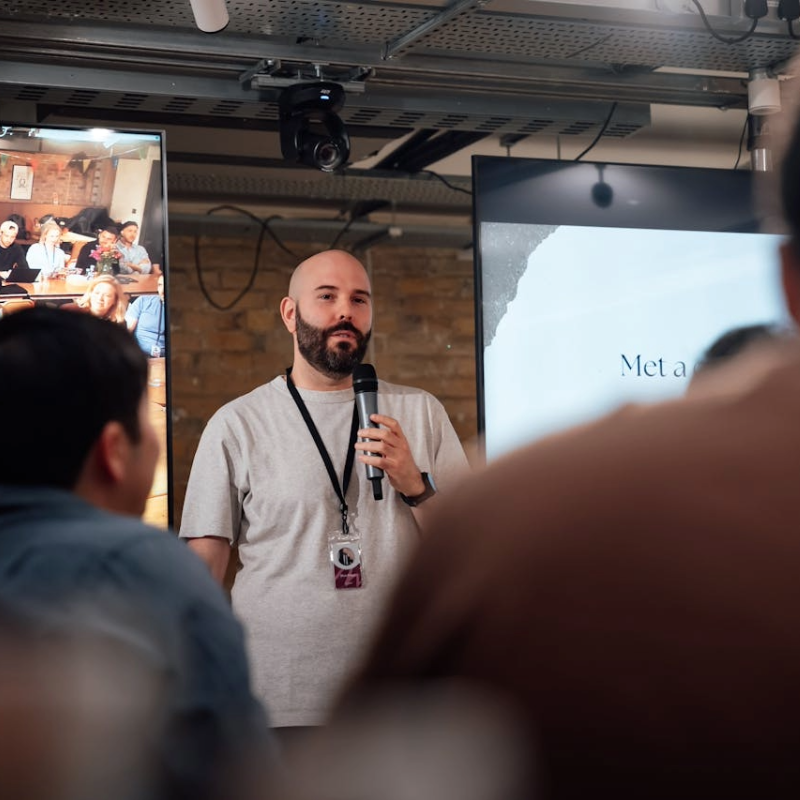

Imagine this: Everything’s set before you go on stage for your speech or presentation.
Your hands are steady. Your slides are clean. You practiced three times—maybe five.
Yet, just before you begin, you feel it. That invisible wobble. The mental static. The tiny voice asking:
“What if I lose them? What if I forget? What if I sound… flat?”
You see, public speaking doesn’t always fall apart because you lack preparation. Sometimes, it falls apart because you lose your center.
When you lose your center, your message loses its gravity.
That is why the most powerful speakers don’t just prepare content; they anchor themselves to something deeper—a private compass that keeps their voice steady when nerves spike, when slides glitch, and when eyes stare back without expression.
In other words, they use a personal “North Star” phrase.
A personal North Star phrase is a short, emotionally loaded sentence that captures your core intention every time you speak.
It’s not your title, thesis, or company’s mission statement. It’s the deeper reason you’re standing up in the first place.
Think of it as your internal headline—the one your audience never sees, but always feels.
When you listen to speakers like Brené Brown, you can sense it. Her research may vary, but her North Star feels consistent: Make courage contagious.
When Simon Sinek speaks, regardless of topic, his energy points toward something like: Help people start with why.
The phrase may not be explicitly stated, but it drives tone, structure, story choice, emphasis, and pauses.
Basically, it keeps everything aligned.
Here’s what happens to many presenters, though: They prepare facts, build slides, and rehearse transitions.
… but once on stage, their focus fractures.
“Am I going too fast?”
“Do they look bored?”
“What slide is next?”
“Did I already say that?”
Here’s the thing: Without an internal anchor, your attention scatters… and when your attention scatters, your presence weakens.
A North Star phrase prevents such a drift as it answers one grounding question:
“Why does this matter to me?”
So, when nerves rise, you blank out, and the room feels cold, you return to it.
A North Star phrase works because it shifts your mental frame from performance to purpose.
When your inner dialogue changes from:
“How am I doing?”
… to:
“Am I serving my North Star?”
… your nervous system relaxes. You stop performing and start leading.
This is what makes certain TED speakers so compelling. The most memorable presenters don’t sound like they’re reciting; they sound anchored.
They know the one emotional outcome they’re trying to create, and everything flows from that.
Now, how can you create your own North Star phrase?
Your phrase should be short (5–8 words ideally), emotionally charged, contribution-focused, and easy to recall under pressure.
It should not always be clever but it should always be clear.
-
Step 1: Ask Yourself This Question
-
Step 2: Turn That Feeling Into a Commitment
-
Step 3: Test It Under Pressure
“If my audience remembers only one feeling after I speak, what do I want it to be?”
Clarity?
Confidence?
Urgency?
Permission?
Belonging?
Your North Star lives there.
For example:
“Make clarity feel simple.”
“Help them believe they can.”
“Challenge comfortable thinking.”
“Make growth feel possible.”
“Turn confusion into confidence.”
Notice the structure: action + outcome.
Your North Star should be directional and forward-moving.
Before you speak, whisper your North Star to yourself.
During your opening pause, repeat it internally.
When you hit a rough patch, mentally return to it.
If it steadies you, it works. If it feels vague, refine it.
The Hidden Power: Consistency Over Time
You see, the real magic of a North Star phrase shows up across multiple talks.
Imagine yourself speaking at five events this year…
Your topics, audiences, and formats vary.
Only your North Star remains.
Over time, people will begin to associate you with a feeling. This is how thought leaders build recognizable presence.
Consider speakers like Mel Robbins. Whether she’s discussing habits, anxiety, or productivity, the underlying current often feels like: Take control of your life now.
That throughline builds trust. Your North Star does the same.
So, try this before your next talk:
- Stand still for 10 seconds.
- Take one slow breath.
- Repeat your North Star phrase silently.
- Visualize one audience member benefiting from it.
- Begin.
No hype. No psyching yourself up. Just alignment.
You don’t need to inflate your energy; you simply need to aim it.
… but what if you don’t have your North Star phrase yet?
Then your next speech is the ideal laboratory!
After you finish, reflect:
“When did I feel most alive?”
“Which moment felt most authentic?”
“What reaction felt most meaningful?”
Reverse-engineer the intention behind that moment.
That’s your draft North Star.
Then, refine it, live with it, and use it again. It will evolve and that’s okay.
The Quiet Advantage
Public speaking advice often focuses on volume, gestures, hooks, storytelling frameworks, slide design, and stage presence.
Don’t get us wrong; all of them are useful.
The thing is, none of them matter if you’re internally scattered.
That’s why a personal North Star phrase is important!
Yes, it’s invisible to the audience… but it shapes everything they experience.
On your part as the speaker:
- It keeps you steady when adrenaline spikes.
- It keeps your message cohesive.
- It keeps your confidence rooted in service.
Perhaps most importantly…
It reminds you why you chose to speak in the first place.
After all, when you know your direction, you don’t fear the stage. Instead, you navigate it smoothly and effectively.
We hope you’ll keep these tips in mind the next time you prepare for a talk on stage!
About The Dynamic Marketing Communiqué’s
“Thursdays: Speak on the Shoulders of Giants”
In a meeting with one person…
… a boardroom with five people…
… or a huge venue with hundreds of people…
—whatever the situation or setting, it’s very important to learn and eventually master the art of public speaking.
No matter what, you always need to effectively get your message across.
What good is a presentation with awesome content if you don’t deliver it properly?
Every Thursday, we publish different tips, insights, and secrets on how you can improve your presentation skills to captivate your audience and lead interesting discussions.
The need for great presentation skills applies EVERYWHERE.
(Small meetings with your team, big meetings with your boss, an important marketing pitch, speaking engagements for events with a big audience, etc.)
Learning these skills is not just for the corporate world. Being in other industries such as the Arts, Information Technology, Medicine, and Education while knowing how to communicate and present well will definitely give you an edge.
Have that advantage.
Hope you find this week’s public speaking tip interesting and helpful.
Stay tuned for next Thursday’s “Speak on the Shoulders of Giants!”
Cheers,
Henry Desai
Managing Director
Valens Dynamic Marketing Capabilities
Powered by VX Dynamic
www.vxdynamic.com
