


Everyone checks the time without thinking.
On their phone…
On their wrist…
On the wall of a subway station while rushing to somewhere else…
However, imagine standing in a familiar place, staring at a clock, and feeling something quietly unravel. The hands are there, but what they mean no longer connects.
Minutes stretch…
Hours blur…
Time slips out of sync with reality…
This is where one of the most emotionally arresting guerrilla marketing campaigns in recent years begins—not with a message, a logo, or a call to action, but with a feeling most people have never experienced.
Turning an Invisible Struggle Into a Public Experience
Alzheimer’s disease affects over 10.42 million people in China, the highest number globally. Yet despite its prevalence, the disease remains deeply misunderstood, especially by those untouched by it.
The emotional distance is vast. Statistics inform, but they rarely move people.
Dentsu China, partnering with Jian Ai Elderly Charity Center and STDecaux, set out to close this empathy gap.
The challenge wasn’t awareness alone but also understanding.
“How do you make the public feel what Alzheimer’s patients experience every day?”
The answer came from an unlikely place: The “Lost in Time” campaign.
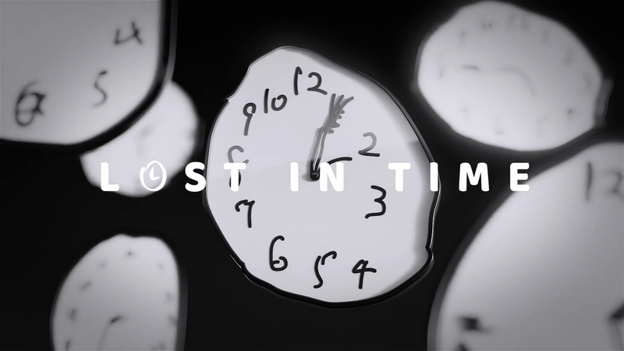
Photo from LBBOnline
The Clock Drawing Test (CDT) is a globally recognized method used to screen for early-stage Alzheimer’s. Here, patients are asked to draw a clock with a specific time.
What seems simple actually reveals a complex breakdown of cognitive abilities—memory, spatial awareness, abstract thinking, mathematics, and temporal navigation.
For Alzheimer’s patients, clocks often stop making sense.
Numbers drift…
Hands overlap…
Time loses structure…
Instead of explaining this medically, the campaign did something far more radical: It showed it.
Dentsu transformed real clock drawings created by elderly Alzheimer’s patients into physical clocks and large-scale installations, bringing the distorted perception of time into the real world.
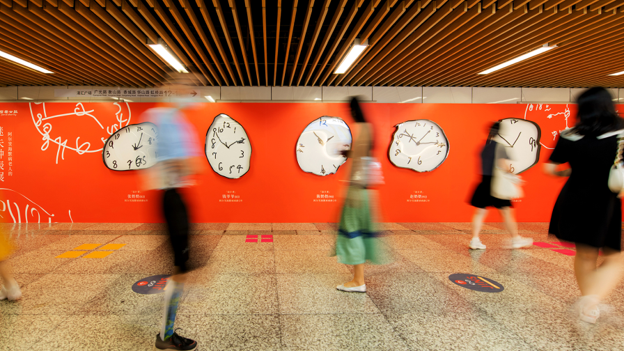
Photo from Dentsu Creative
Launched on World Alzheimer’s Day (September 21, 2023) during China Brain Health Month, the campaign took over Shanghai’s Xujiahui Metro Station, a high-traffic public space where time is everything.
Commuters encountered five abnormal clocks, each reflecting the altered reality of Alzheimer’s patients.
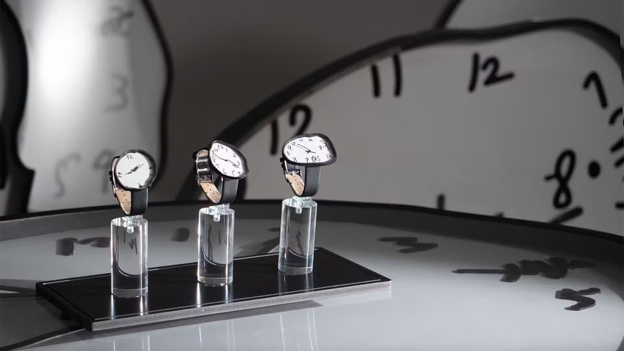
Photo from Dentsu
These weren’t abstract art pieces; they were faithful recreations of patient drawings—raw, imperfect, and deeply human.
What else?
The experience didn’t stop at observation!
- Watch stickers and wearable timepieces allowed people to physically try on distorted clocks.
- Real timepieces, created from patient artwork, were auctioned for charity.
- Participating patients received the final timepieces, turning their confusion into contribution.
Clearly, in a space usually dominated by ads shouting for attention, the installation whispered… and people stopped to listen.
This is guerrilla marketing at its most refined: unexpected, contextually powerful, emotionally grounded, and impossible to ignore.
Why the Campaign Worked So Powerfully
What made “Lost in Time” extraordinary wasn’t just its execution but also its restraint.
- It didn’t explain Alzheimer’s immediately.
- It didn’t rely on shock or pity.
- It didn’t “sell” awareness.
Instead, it invited people to experience confusion before naming it.
By using real patient artwork, the campaign avoided abstraction and leaned into authenticity. Every distorted clock was proof—not a metaphor—of how Alzheimer’s reshapes perception.
The public didn’t just learn about the disease; they momentarily lived inside it.
That emotional shift was where empathy started to form.
The impact of the campaign was both emotional and measurable.
Engagement & Reach:
- 2.75 million people engaged with the exhibition
- 17.9 million total visits to the exhibition, signaling sustained interest
- 129 million total impressions across platforms
- 21 million people reached across diverse demographics
Media & Cultural Impact:
- 493 press mentions and social posts, driving widespread conversation
- Strong amplification through media outlets and influencers
- Recognition at Cannes Lions 2024, winning a Bronze Lion for Outdoor Campaigns
Fundraising & Participation:
- +106% year-over-year increase in donations
- 120,000+ participants joined the auction of patient-designed timepieces
- Funds directly supported Alzheimer’s awareness, research, and patient care
These results prove a crucial point: When people feel, they act.
At its core, “Lost in Time” is a masterclass in innovation with purpose. By transforming a professional medical assessment into a public art experience, the campaign made early detection and brain health accessible without oversimplifying or sensationalizing the issue.
It reframed Alzheimer’s not as a distant tragedy, but as a shared human concern. After all, time is something everyone thinks they understand… until they don’t.
A Blueprint for Meaningful Guerrilla Marketing
Overall, “Lost in Time” demonstrates what happens when creativity serves humanity instead of ego. It proves that guerrilla marketing doesn’t have to be loud to be disruptive, or shocking to be memorable.
Sometimes, the most powerful campaigns don’t interrupt your day.
They stop time, just long enough for you to see the world through someone else’s eyes.
Once you’ve felt that, you don’t easily forget it.
About The Dynamic Marketing Communiqué’s
“Fridays: Gorillas of Guerrilla Marketing”
Jay Conrad Levinson (1984) said that Guerrilla Marketing “works because it’s simple to appreciate, easy to execute, and inexpensive.”
Guerrilla Marketing is unconventional.
Looking beyond the traditional ways of advertising, marketers and advertisers need to spice things up in order for their brand to have campaigns that not only make an impact but also stick to their target market’s mind.
Guerrilla Marketing usually aims to have direct contact with consumers.
This type of direct contact should spark an emotional reaction that leads to consumers effectively remembering the brand.
It’s about making a big impression and making that impression last a long time (if not forever).
Guerrilla Marketing can be inexpensive.
The effect of this is being able to create a buzz around the brand, and the strategy used to market it. Almost everything is passed around through word-of-mouth.
Word-of-mouth is one of the greatest outcomes and it usually doesn’t cost anything.
This is every business’ or brand’s dream!
Every Friday, we publish tips, examples, and other useful content on unconventional ways of marketing and promotion.
Learn more about how to grab your target market’s attention and make an amazing first and lasting impression without having to spend a lot of money.
Businesses don’t really need to spend much for a guerrilla campaign. You do not need a big budget to be successful. You just need creativity and a good imagination.
Hope you find this week’s guerrilla marketing insight interesting and helpful.
Stay tuned for next Friday’s “Gorillas of Guerrilla Marketing!”
Cheers,
Dyane Diasanta
Senior Content Writer
Valens Dynamic Marketing Capabilities
Powered by VX Dynamic
www.vxdynamic.com
