


Founded in 1999, Salesforce is a household name in the CRM and software-as-a-service (SaaS) spaces.
For those who may not know, the firm offers cloud-based CRM services for sales, marketing, and commerce. The company also acquired Slack in 2020, giving it a foothold in the communications platform space.
Since its founding, Salesforce has slowly built itself into one of the world’s most valuable companies not only in CRM and SaaS but in tech and enterprise software as a whole.
To understand how this multi-billion dollar thrived, we have to take a look at one of the key people behind it.
His name?
Marc Benioff!
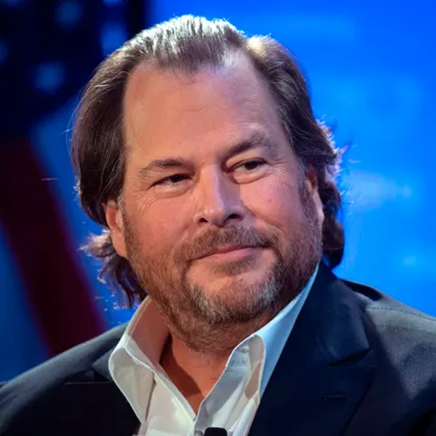
Photo from Forbes
Born in 1964, Benioff was raised in the San Francisco Bay Area and during his younger years, he displayed an enthusiasm for tech and a zeal for entrepreneurship.
When he was in high school, Benioff became obsessed with software after he stumbled upon a computer lab. By 1979 and at the age of 15, he and some friends started a software company called Liberty Software to make games for the Atari 800, a popular gaming console at the time.
Once he graduated from high school, he pursued a degree in business administration from the University of Southern California. During this time, he also wrote code for the Macintosh at Apple as an intern.
Upon his graduation from college, Benioff joined Oracle Corporation and worked there for 13 years in a variety of sales, marketing, customer service, and product development roles.
What’s more?
He became the company’s youngest vice president during his tenure and he was known as a protégé of Larry Ellison, one of the co-founders of Oracle Corporation.
Despite having reached those heights, Benioff eventually decided to chart his own path, leading him to co-found Salesforce in 1999 alongside Parker Harris, Dave Moellenhoff, and Frank Dominguez.
At present, he also serves as the company’s CEO.
Taking A Gamble on SaaS and Cloud Computing
Salesforce was founded with the goal of making CRM tools accessible to salespeople in businesses of all sizes.
According to Harris, Benioff wanted to “make CRM as easy as buying a book on Amazon.”
At the time, the company set itself apart from other tech companies because it offered its product over the Internet and the cloud, making it an SaaS company.
This was a risk because the cloud and SaaS as a business model were still unproven and few were willing to take a gamble on them.

Photo from Pexels
To further complicate matters, Salesforce was affected by the dot-com bubble bursting at the start of the 2000s, resulting in the firm cutting 20% of its workforce at the time.
Despite this challenge, the company grew significantly over the span of two decades as it established itself as a dominant force in the CRM space, cloud computing, and the broader tech sector. In 2016, it even announced the launch of its artificial intelligence (AI) platform to support several of the company’s cloud services.
As of June 2025, the company has a market capitalization of USD 250 billion and has positioned itself to benefit significantly from the AI boom.
So, what led to Benioff’s success in his business endeavors?
Here are a few of the major reasons:
-
Valuing Trust and Transparency
According to Harris, one of the biggest challenges they faced during the early years of Salesforce was getting companies to trust them with their data.
Due to this, Benioff and his collaborators made it a point to build trust by safeguarding the data of their clients and by being transparent.
-
Adopting A Customer-First Mindset
Prior to the 2000s and the introduction of cloud-based solutions, keeping track of customer metrics and finding out how best to attract and retain them were a massive challenge for many businesses.
To solve this pain point, Benioff came up with Salesforce.
However, what set him and his company apart was that the company was founded with the customers in mind and not because of the desire to make profits.
Through this customer-first mindset, Benioff and his team were able to build a platform that enabled end users to customize the product to fit their unique needs and could be scaled for businesses of any size.
-
Willingness to Keep an Eye Out for the Next Big Thing
Salesforce was founded at a time when the Internet was still in its infancy. While the dot-com mania of the 90s had brought attention to it, there were many who were on the fence about it.
Benioff was undeterred by this, and pushed on with the SaaS and cloud-based model for Salesforce, even if it meant facing some skepticism and a great deal of volatility when the dot-com bubble burst.
His insistence on pursuing this particular business model showed his willingness to keep an eye out for the next big thing, which at the time, was the Internet, even though many had no idea how big nor revolutionary it was going to be.
Two decades later, Benioff still has the same mindset. He believes “AI is the single most important moment in the history of our industry. It will deepen customer relationships, increase productivity and drive higher margins at every company.”
In line with this thinking, he had positioned his company to leverage the benefits of AI, not only from an efficiency standpoint, but also from a growth and customer service perspective.
—
In all his years as an executive, Benioff not only built a multi-billion dollar company, but also a reputation for being one of the tech and business world’s most fervent innovators as he was named by Forbes as “Innovator of the Decade.”
He was also listed as one of the 10 Best-Performing CEOs by Harvard Business Review.
What’s more?
Benioff has built a reputation for being a philanthropist and being an investor in dozens of tech startups.
So, with all these accolades and accomplishments taken into account, it’s unsurprising to see Benioff as a titan in the tech industry and a “Marvel” in the world of business.
His story is definitely something you should take inspiration from, especially if you’re looking to level up your career and business!
About The Dynamic Marketing Communiqué’s
“Mondays: Marketing Marvels”
Too often, industry experts and the marketing press sing the praises of some brand or company’s marketing strategy.
… only for the audience to later find out that its product was a flop, or worse, that the brand or company went bankrupt.
The true ROI in marketing can’t be separated from the business as a whole.
What good is a marketing case study if one can’t prove that the company’s efforts actually paid off?
At the end of the day, either the entire business is successful or it isn’t. And the roles of marketing and communication are always paramount to that success.
Every Monday, we publish a case study that highlights the world’s greatest marketing strategies, marketers, and communicators.
However, the difference between our articles and the numerous ones out there is that we will always make certain that the firm really did generate and demonstrate earning power worthy of study in the first place in keeping with a person’s leadership skills in the area of marketing and/or communication.
We’ll also study the greatest marketing fails and analyze what they did wrong, or what they needed to improve. We all make mistakes, but better we learn from others’ mistakes—and earlier, rather than later.
Hope you find this week’s topic interesting and helpful.
Stay tuned for next Monday’s “Marketing Marvels!”
Cheers,
Adrian Kyle Vergara
Content Writer
Valens Dynamic Marketing Capabilities
Powered by VX Dynamic
www.vxdynamic.com
