


The global beauty and personal care industry generates billions of dollars annually and has never been more competitive.
Industry analysts expect the space to generate a revenue of nearly USD 700 billion in 2026.
Customers are faced with many options to choose from. They have access to thousands of products, many nearly identical in price and formula, sold across countless retailers.
Yet before every product launch, one question still dominates buyers’ minds:
“Will it be available at Sephora?”
For those who aren’t familiar, Sephora is a retailer of personal care and beauty products. It sells products from over 300 brands and it has storefronts located across the globe.
Decades have passed since Sephora’s founding. Throughout those years, many competitors have sprung up.
Yet despite this, Sephora continues to be top of mind for many customers.
Why?
The answer to that question requires us to dig deeper, so keep reading below!
The Go-to Cosmetics Retailer

Photo from Unsplash
Sephora was founded in France in 1969 and is headquartered today in Neuilly-sur-Seine.
Its founder, Dominique Mandonnaud, pioneered what became known as “assisted self-service.”
Unlike other retailers at the time, Sephora let customers test products in-store before buying, giving them the freedom to find what actually worked for them.
The model was a hit. Mandonnaud spent the next two decades expanding Sephora across France, and the brand grew large enough to catch the eye of French luxury conglomerate Louis Vuitton Moët Hennessy (LVMH).
LVMH acquired Sephora in 1997 and has owned it ever since.
Sephora’s product catalog spans clothing, cosmetics, fashion accessories, perfumes, watches, and others.
The company reached record growth between 2023 and 2024. According to an executive, revenue hit roughly EUR 15 billion (or around USD 18.5 billion).
Those are impressive numbers, especially when we consider that Sephora has to compete with other retailers like Amazon, which also has a huge catalog of luxury products in its digital storefront.
That said, how did it continue to remain competitive?
The answer boils down to two things: Branding and collaborations.
More Than A Beauty Retailer
Sephora is often seen as a beauty retailer… and while that characterization is very much true, it’s so much more than that.
You see, Sephora isn’t just a store that sells products; it also creates an environment that encourages customers to buy and curates offerings that create excitement and desire.
This philosophy is reflected in the company’s store design. Each location is adorned with bright lights, and products are placed in a way that encourages buyers to test them out.
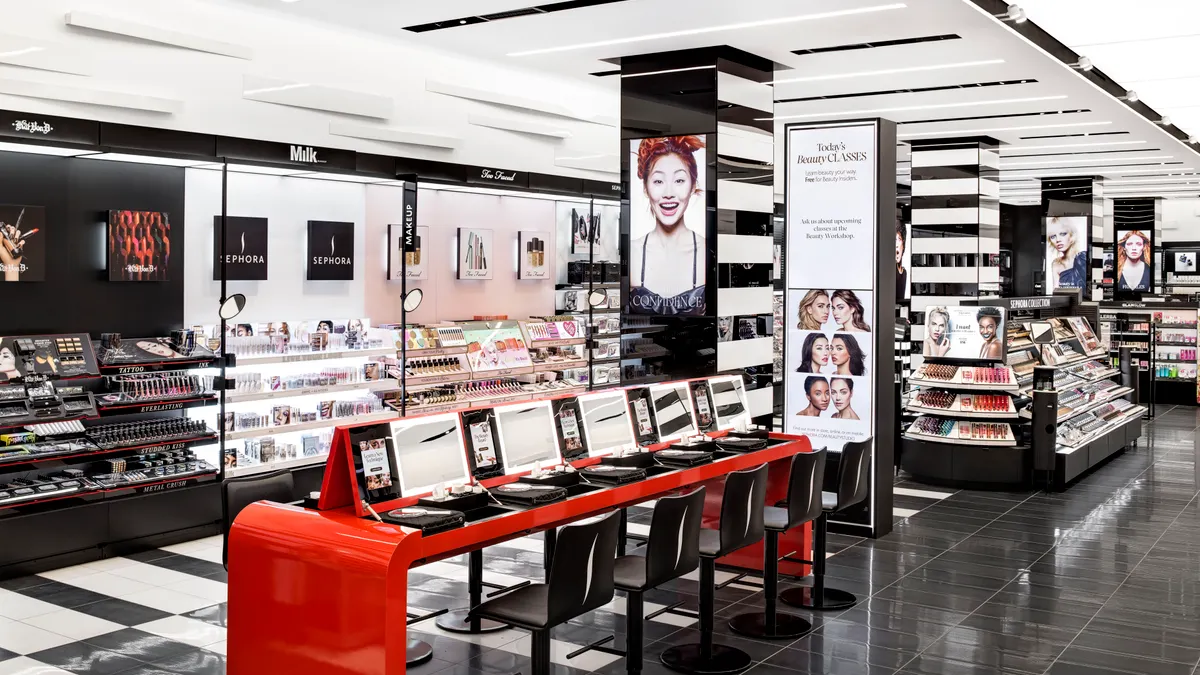
Photo from Retail Dive
Store design is only part of the equation, though. Sephora’s true bread and butter is its role as a tastemaker.
The company creates hype for its customer base by offering products that people want to buy—a feat achieved through leveraging customer insights and forming extensive partnerships with trendy and high-end brands.
Through the years, Sephora has inked exclusive partnerships with heavyweight brands like Rare Beauty, Fenty Beauty, Rhode, and a host of others.
The retailer also closely monitors social media trends since they help in identifying products that people are excited to buy.
It has gathered customer insights from platforms like TikTok to identify popular brands or products that it could offer in its stores.
- Since the consumption of beauty products these days is driven by social media engagement, the beauty retailer is able to position itself as the retailer of choice for anyone looking for cosmetics, fragrances, and other luxury items.
The Hallmarks of Return Driven Firm
Sephora’s playbook is best explained through the lens of two of Return Driven Strategy’s (RDS) tenets:
-
Partner Deliberately
According to Professor Joel Litman and Dr. Mark L. Frigo in the book, “Driven”:
“The strongest partnerships bring unique assets together that allow the firm to innovate, brand, and deliver unique need-fulfilling offerings.”
The retailer’s understanding and clever use of social media allowed it to find out what its customers truly want.
Once the retailer identified these products, they partnered with the people or companies behind the products, leading customers to make trips to Sephora’s physical and digital storefronts.
-
Brand Offerings
In “Driven,” Professor Litman and Dr. Frigo emphasized the importance of branding activities.
According to them:
“Proper branding activities build an indelible connection in the mind of customers between their explicitly understood need and the offering that uniquely fulfills it.”
Sephora’s strategies have enabled it to become synonymous with beauty and cosmetics, successfully building a bridge between it and the hearts and minds of its customers.
It’s no wonder then, that whenever a new beauty product gets announced, the first thing customers ask is whether this new product is available at Sephora.
The main takeaway from Sephora’s story?
The most enduring and high-return businesses don’t just sell products. They also build a brand that has a strong mental and emotional connection with customers.
—
If you’re looking to gain a better understanding of Return Driven Strategy and Career Driven Strategy, we highly recommend checking out “Driven” by Professor Litman and Dr. Frigo.
Click here to get your copy and learn how this framework can help you in your business strategies and ultimately, in ethically maximizing wealth for your firm.
About The Dynamic Marketing Communiqué’s
“Tuesdays: Return Driven Strategy”
In the book, “Driven,” authors Professor Joel Litman and Dr. Mark L. Frigo said that the goal of every long-term successful business strategy should incorporate the combined necessity of “making the world a better place” and “getting wealthy.”
That is why they created Return Driven Strategy and Career Driven Strategy—frameworks that were built to help leaders and professionals plan and evaluate businesses so they can also help others achieve their organizational goals and career goals.
The frameworks describe the plans and actions that drive returns for anyone in an organization such as independent contractors, marketers, brand managers, communicators, and other people in any field. These actions lead to the creation of wealth and value for customers, employees, shareholders, and the society.
Every Tuesday, we’ll highlight case studies, business strategies, tips, and insights related to Return Driven Strategy and Career Driven Strategy.
In planning, building, or managing brands and businesses, these strategies, case studies, and guidelines will help you choose what specific actions to take and when to take them.
Hope you find this week’s topic interesting and helpful.
Stay tuned for next Tuesday’s “Return Driven Strategy!”
Cheers,
Adrian Kyle Vergara
Content Writer
Valens Dynamic Marketing Capabilities
Powered by VX Dynamic
www.vxdynamic.com
