


The auto industry has transformed over the past decade, and the biggest disruptor has been the development and proliferation of electric vehicle (EV) technology.
For more than a century, the internal combustion engine ruled the road, and carmakers built their entire business around it.
Then, EV technology arrived and advanced rapidly, with carbon-reduction regulations giving it an extra push in terms of adoption.
As a result, industry insiders began asking whether the combustion engine’s days were numbered.
Not so fast, though. Gas-powered vehicles haven’t faded into obscurity. Roughly 240 million vehicles on U.S. roads still run on gas.
No matter which way the industry goes, one carmaker has positioned itself to thrive.
Be it gas, hybrid, or electric, this Japanese carmaker sells them all… and its name is Toyota.
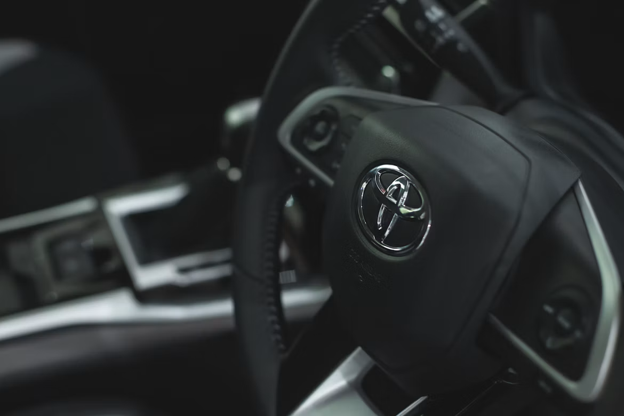
Photo from Unsplash
Toyota is one of the biggest automakers in the world.
The Japanese carmaker sold over 11 million vehicles globally in 2025, outperforming German rival Volkswagen Group, which sold nearly 9 million cars.
Toyota has had a long history of being an innovative company. In the 1960s, it took the Japanese car market by storm with the creation of the highly popular Toyota Corolla.
By 1986, the automaker managed to become the first import automaker that sold over 1 million vehicles in the U.S. in a single year. Three years later, Lexus, the company’s luxury vehicle division was founded.
Over the past several decades, Toyota established itself as one of the leaders of the global automotive industry.
It has done this partly by expanding its product portfolio to include the following:
- Hybrid vehicles
- Fully-electric vehicles
- Hydrogen-powered vehicles
According to early 2026 data, Toyota, alongside Hyundai and Honda, control 86% of the hybrid vehicle market in the U.S.
Toyota controls half of that market, and even managed to sell 600,000 hybrids in the first half of 2026.
This is proof that Toyota’s investments in various vehicle propulsion technologies has enabled it to stay flexible in an evolving automotive market.
Said another way, Toyota, instead of relying on a single, high-risk bet, diversified its investments into multiple technologies.
Regardless of which automotive technology performs well, the carmaker would always have a slice of that market.
Conversely, it’s insulated from industry-wide disruptions due to its diversification.
Take fully-electric vehicles for example:
When EV adoption mandates were clawed back in 2025, the prices of EVs soared dramatically, shrinking customer demand.
Toyota’s EV segment was exposed… but whatever it lost in that segment was cushioned by the sales it generated in other product categories.
Today, the Japanese carmaker continues to move forward with its “multi-pathway” approach, committing to using different sources of energies for its cars rather than focusing on one form of propulsion technology.
An “All of the Above” Approach
Toyota’s approach to its business is best explained through the lens of Return Driven Strategy’s (RDS) tenth tenet: Balance Focus and Options.
According to Professor Joel Litman and Dr. Mark L. Frigo in the book, “Driven,” high-performance businesses “leverage uncertainty in order to succeed.”
Said another way, instead of committing to one approach in a fast-moving industry, Toyota adopted an “all of the above” approach to remain competitive.
Toyota’s success also imparts valuable lessons to leaders, managers, business owners, and professionals:
- Avoid All-or-Nothing Bets – Big bets yield great rewards, but they expose businesses and leaders to even bigger risks if those bets don’t pan out.
- Stay Flexible – Consumer preferences, industries, and regulation constantly evolve. A business must be able to adapt when one or all of those things change.
The bottom line?
Toyota’s success in the automotive industry didn’t just revolve around designing and selling great cars; it adopted a strategy that enabled it to thrive amidst uncertainty and constant change.
—
If you’re looking to gain a better understanding of Return Driven Strategy and Career Driven Strategy, we highly recommend checking out “Driven” by Professor Litman and Dr. Frigo.
Click here to get your copy and learn how this framework can help you in your business strategies and ultimately, in ethically maximizing wealth for your firm.
About The Dynamic Marketing Communiqué’s
“Tuesdays: Return Driven Strategy”
In the book, “Driven,” authors Professor Joel Litman and Dr. Mark L. Frigo said that the goal of every long-term successful business strategy should incorporate the combined necessity of “making the world a better place” and “getting wealthy.”
That is why they created Return Driven Strategy and Career Driven Strategy―frameworks that were built to help leaders and professionals plan and evaluate businesses so they can also help others achieve their organizational goals and career goals.
The frameworks describe the plans and actions that drive returns for anyone in an organization such as independent contractors, marketers, brand managers, communicators, and other people in any field. These actions lead to the creation of wealth and value for customers, employees, shareholders, and the society.
Every Tuesday, we’ll highlight case studies, business strategies, tips, and insights related to Return Driven Strategy and Career Driven Strategy.
In planning, building, or managing brands and businesses, these strategies, case studies, and guidelines will help you choose what specific actions to take and when to take them.
Hope you find this week’s topic interesting and helpful.
Stay tuned for next Tuesday’s “Return Driven Strategy!”
Cheers,
Adrian Kyle Vergara
Content Writer
Valens Dynamic Marketing Capabilities
Powered by VX Dynamic
www.vxdynamic.com
