
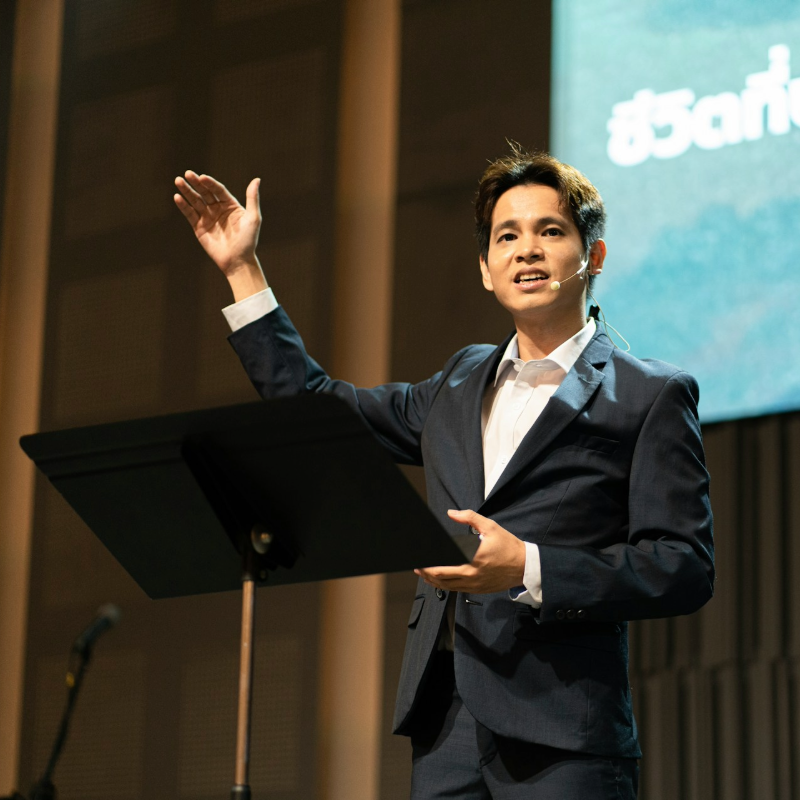

Let’s be honest: In public speaking, your audience won’t remember everything you say.
However, they will remember how you made them feel. Surprisingly, they may also remember something else—something you didn’t even realize you were teaching them to remember.
A movement. A raised finger. An open palm. A triangle drawn in the air.
You see, great speakers don’t just talk in words; they build visual anchors in space. When done intentionally, such movements become powerful memory triggers that lock ideas into the minds of listeners.
Welcome to one of the most underrated tools in public speaking: gesture hooks!
A gesture hook is a deliberate, repeatable physical movement tied to a specific idea, concept, or point in your speech.
Think of it as a “visual bookmark.”
Every time you revisit that idea, you repeat the same gesture in the same physical space. Over time, the audience subconsciously connects that motion with that message.
It’s not random hand waving; it’s structured physical storytelling.
Examples:
When explaining three pillars of leadership, you physically assign each pillar a place in the air: left, center, and right.
When contrasting “problem” and “solution,” you place them on opposite sides of your body.
When talking about growth, you move your hand upward.
The result of that?
Your speech becomes easier to follow and remember, and becomes dramatically more engaging.
Besides, human beings are visual processors. People remember images more easily than abstract words.
This is why TED speakers often move intentionally across the stage. Watch presenters like Simon Sinek or Brené Brown and you’ll notice their movements are not accidental. When they introduce a concept, they frequently anchor it with a consistent gesture or spatial placement.
This taps into:
- Spatial Memory – The human brain is wired to remember “where” things are. When you assign ideas to physical space, you leverage this built-in system.
- Dual Coding Theory – When information is presented both verbally and visually (in this case, through movement), retention increases significantly.
- Pattern Recognition – Repetition creates familiarity… familiarity builds clarity… and clarity builds trust.
Simply said, gesture hooks create predictable patterns that help your audience follow your logic without cognitive strain.
So, how can you effectively create gesture hooks in your next speech or presentation?
Here’s a simple, practical framework you can use immediately:
-
Step 1: Identify Your Core Anchors
Pick two to five key ideas in your speech. These might be:
– The three pillars of your framework
– The problem vs. the solution
– Past, present, future
– Fear vs. courage
– Limiting beliefs vs. empowering beliefs
Remember: If everything is important, nothing is. So choose the ideas that must be remembered.
-
Step 2: Assign Physical Space
Now, literally assign each idea a location around you.
Example:
– Left side = “The Problem”
– Center = “The Shift”
– Right side = “The Result”
Or:
– Low gesture = “Where you are now”
– Mid-level = “The work”
– High gesture = “The breakthrough”
The key is to be consistent. Every time you reference that concept, gesture in the same location. You’ll see, your audience will begin mapping your ideas spatially without realizing it.
-
Step 3: Repeat Without Announcing It
You don’t need to say, “This is my gesture for confidence.”
Just do it. Repetition makes it stick.
The third time you point to that same spot in the air when referencing “discipline,” your audience will already associate the two. That’s when the hook is set.
BUT!
Be careful, though. Even powerful tools can backfire if misused.
So avoid overcomplicating your gesture hooks. You don’t need 12 gestures or a gesture for every word you’ll say. Two to five movements is enough.
Additionally, don’t be too robotic. Gesture hooks should feel natural. If they look forced, they will only distract your audience.
Last but not the least…
Don’t forget to practice physically! Rehearse your speech and your gestures in front of a mirror or record yourself.
Always keep in mind that you’re choreographing ideas, not just sentences.
Why This Matters More Than Ever
In an age of short attention spans and endless distractions, clarity is a competitive advantage.
… and memorability is the currency of influence.
So, before your next presentation, try this:
- Identify your three most important points.
- Assign each one a distinct physical location.
- Rehearse referencing them consistently.
- Recap using those same gestures.
… then watch what happens.
You’ll see—by doing so, you’ll feel more grounded, your message will feel more organized, and your audience will retain more than you expect.
Besides, words inform and stories connect… but it is your movement that imprints on your audience.
When you use gesture hooks, you’re not just speaking; you’re also sculpting your ideas into the air. You’re giving your audience invisible handles to grab onto.
… and when they walk away repeating your message later, they might even unconsciously repeat your gestures too.
That’s when you know your hook has landed.
Keep these tips in mind for your next public speaking engagement!
About The Dynamic Marketing Communiqué’s
“Thursdays: Speak on the Shoulders of Giants”
In a meeting with one person…
… a boardroom with five people…
… or a huge venue with hundreds of people…
—whatever the situation or setting, it’s very important to learn and eventually master the art of public speaking.
No matter what, you always need to effectively get your message across.
What good is a presentation with awesome content if you don’t deliver it properly?
Every Thursday, we publish different tips, insights, and secrets on how you can improve your presentation skills to captivate your audience and lead interesting discussions.
The need for great presentation skills applies EVERYWHERE.
(Small meetings with your team, big meetings with your boss, an important marketing pitch, speaking engagements for events with a big audience, etc.)
Learning these skills is not just for the corporate world. Being in other industries such as the Arts, Information Technology, Medicine, and Education while knowing how to communicate and present well will definitely give you an edge.
Have that advantage.
Hope you find this week’s public speaking tip interesting and helpful.
Stay tuned for next Thursday’s “Speak on the Shoulders of Giants!”
Cheers,
Henry Desai
Managing Director
Valens Dynamic Marketing Capabilities
Powered by VX Dynamic
www.vxdynamic.com
