
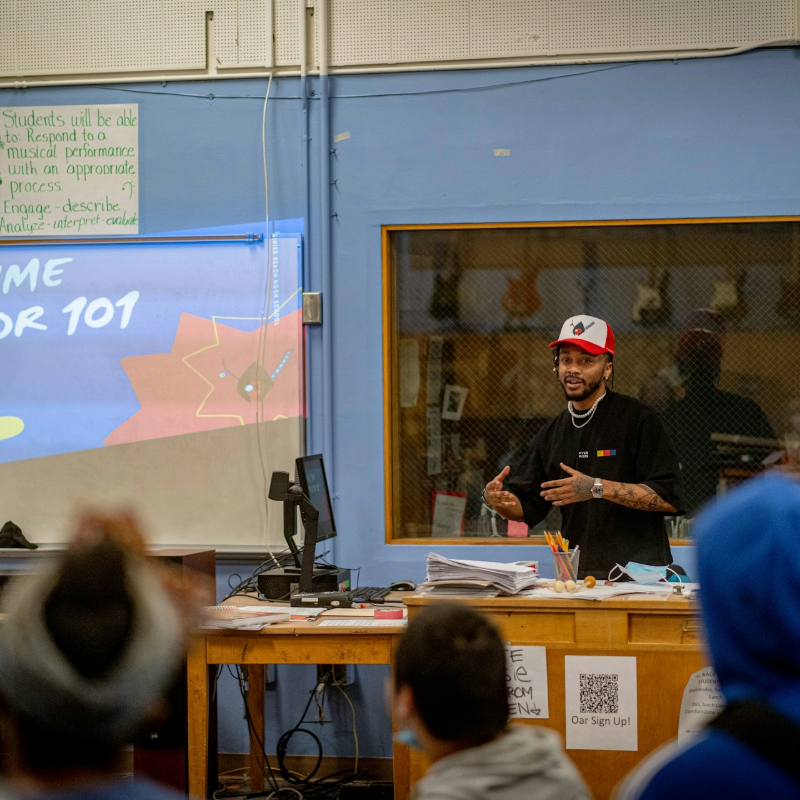

Public speaking has long been treated as a one-way street: The speaker delivers, the audience receives.
However, modern audiences are conditioned by interactivity. From mobile apps to immersive media, people expect to participate, not just observe.
Borrowing principles from game design can transform a standard talk into an engaging, high-energy experience that keeps listeners invested from start to finish.
Disclaimer: Gamifying your talk doesn’t mean turning your presentation into a literal video game. It simply means strategically weaving in elements of play, challenge, and reward to activate attention and deepen learning.
Why Gamification Works for Public Speaking
Game mechanics tap into fundamental human psychology as they trigger curiosity, motivation, and a sense of progress. When audiences feel like participants instead of spectators in your talk, they’re more likely to stay focused and retain information.
Gamification introduces:
- Clear goals – Audiences understand what they’re trying to achieve or learn.
- Immediate feedback – Interaction provides instant reinforcement.
- Progress markers – Structured milestones keep energy moving forward.
- Emotional investment – Play sparks enjoyment, which in turn enhances memory.
In short, games create momentum… and momentum is the antidote to boredom.
To gamify your presentation effectively, you have to put yourself in the shoes of a game designer.
Think about this: Every successful game has structure. Your talk should too.
Here’s how:
-
Establish a Mission
-
Use Levels or Stages
-
Introduce Micro-Challenges
-
Build in Rewards
Frame your presentation as a shared challenge. Instead of simply outlining what you’ll cover, present a compelling objective the audience can rally around.
Examples:
“By the end of this session, we’ll solve…”
“Your mission today is to discover…”
“Together, we’re going to unlock…”
See?
A mission creates narrative tension. People lean in when they sense a journey unfolding.
Break your talk into clearly defined segments that feel like levels in a game. Each stage should build on the previous one, offering a sense of progression.
Signal transitions explicitly:
“Level one: Understanding the problem.”
“Level two: Testing solutions.”
“Final level: Applying what you’ve learned.”;
This structure helps audiences mentally organize information while maintaining anticipation.
Short interactive challenges keep energy high. These don’t need to be elaborate. Simple prompts can activate participation:
– Quick polls or show-of-hands questions
– Brief partner discussions
– Prediction exercises
– Scenario problem-solving
The key is immediacy. Challenges should be fast, focused, and directly tied to your message.
Rewards don’t have to be physical prizes. Recognition, humor, or shared victories can be just as effective.
Examples include:
– Celebrating clever answers
– Displaying audience contributions
– Acknowledging group achievements
– Creating moments of collective success
These micro-rewards reinforce engagement and create positive emotional spikes.
Now… what are some practical techniques for gamifying your talk?
-
Interactive Story Paths
-
Live Quests
-
Scoreboards and Progress Tracking
-
Collaborative Challenges
Present the audience with choices that influence how you proceed. Offer two scenarios and let the group vote on which one to explore first. This sense of agency increases investment and curiosity.
Assign small tasks tied to your content. For example: Ask listeners to identify real-world applications of a concept and share them. Frame it as a quest: “Your challenge is to spot…”
Visual progress indicators—whether a simple checklist or a slide-based tracker—give your audience a sense of advancement. This is because watching progress unfold satisfies the human desire for completion.
Divide the audience into small teams for brief activities. Collaboration introduces social energy and friendly competition, which naturally heightens engagement.
A friendly reminder, though: Gamification should amplify your message, NOT distract from it. The goal isn’t entertainment for its own sake but meaningful engagement.
Ask yourself:
“Does this interaction reinforce my key message?”
“Will it clarify or deepen understanding?”
“Does it maintain flow rather than interrupt it?”
When play aligns with purpose, it becomes a powerful teaching tool.
Besides, gamifying your talk shifts your role from lecturer to facilitator. You become the architect of an experience rather than the sole source of information.
This mindset encourages flexibility. Like a good game master, you read the room, adapt to audience responses, and adjust pacing accordingly.
As a result, the talk becomes a dynamic exchange rather than a scripted monologue.
Creating Memorable Experiences
In an era where attention is fragmented and expectations are high, speakers who embrace interactive design gain a powerful advantage.
By weaving game elements into your presentations, you don’t just capture attention; you also sustain it.
A gamified talk invites audiences to step inside the message, explore it, and claim it as their own.
… and when people feel like players in the story you’re telling, they don’t just listen.
They remember.
Keep these tips in mind the next time you prepare for a presentation!
About The Dynamic Marketing Communiqué’s
“Thursdays: Speak on the Shoulders of Giants”
In a meeting with one person…
… a boardroom with five people…
… or a huge venue with hundreds of people…
—whatever the situation or setting, it’s very important to learn and eventually master the art of public speaking.
No matter what, you always need to effectively get your message across.
What good is a presentation with awesome content if you don’t deliver it properly?
Every Thursday, we publish different tips, insights, and secrets on how you can improve your presentation skills to captivate your audience and lead interesting discussions.
The need for great presentation skills applies EVERYWHERE.
(Small meetings with your team, big meetings with your boss, an important marketing pitch, speaking engagements for events with a big audience, etc.)
Learning these skills is not just for the corporate world. Being in other industries such as the Arts, Information Technology, Medicine, and Education while knowing how to communicate and present well will definitely give you an edge.
Have that advantage.
Hope you find this week’s public speaking tip interesting and helpful.
Stay tuned for next Thursday’s “Speak on the Shoulders of Giants!”
Cheers,
Henry Desai
Managing Director
Valens Dynamic Marketing Capabilities
Powered by VX Dynamic
www.vxdynamic.com
