


Valve Corporation (a.k.a. Valve) is one of gaming’s most recognizable companies, having developed beloved game franchises such as “Half-Life,” “Counter-Strike,” “Portal,” “Left 4 Dead,” “Team Fortress,” and “Dota.”
It is also the developer of Steam, a digital distribution service and storefront that facilitates the sale of video games, game soundtracks, other types of software and hardware such as the Steam Deck, and has over 132 million monthly active users.
Steam was originally released by Valve to provide game updates for titles released by the company.
By late 2005, Valve expanded Steam’s functionality to include the distribution of third party titles, alongside features such as game serve matchmaking, anticheat measures, social networking, and game streaming services.
Since its founding in 1996, Valve has left an indelible mark in the gaming industry, having released games that have achieved critical acclaim and by putting up a digital storefront that both gamers and developers continue to rely on.
Simply said, Valve is an industry juggernaut and is in a league of its own.
To understand how this came to be, we need to take a deep dive into its president and co-founder.
His name?
Gabe Newell!
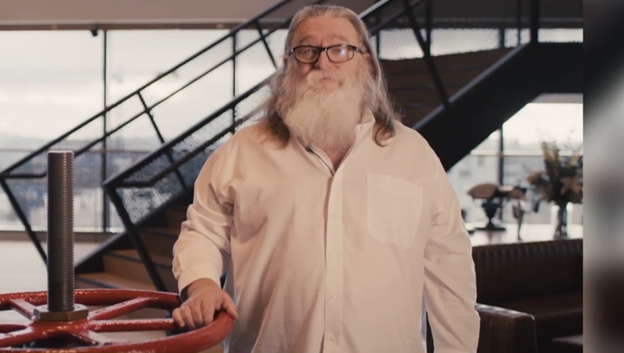
Photo from PC Gamer
Newell’s journey into the world of gaming did not begin in the industry. Instead, his origins can be traced back to tech.
In 1980, Newell enrolled at Harvard University, but dropped out 3 years later when he was convinced into taking a job in Microsoft where he spent 13 years as a programmer and technical executive.
In fact, he was involved in the first three iterations of Microsoft’s popular Windows operating system.
Looking back at his tenure in the tech firm, Newell stated in an interview that he learned more during his first 3 months in Microsoft than he did the entire time he was at Harvard.
Eventually, Newell left Microsoft in 1996 and co-founded Valve together with Mike Harrington.
In 1998, Valve released “Half-Life,” a first-person shooter game that attained critical and commercial success. The company would then continue to develop and release expansions for the gamer until 2001.
A year after the release of “Half-Life,” Valve went on to release “Team Fortress” and the first iteration of “Counter-Strike.”
Satisfied with the success of Valve during its early years, Harrington sold his stake to Newell in 2000.
During the 2000s and early 2010s, Valve would go on to launch Steam (2002), “Half-Life 2” (2004), “Portal” (2007), “Left 4 Dead” (2008) and its sequel (2009), “Portal 2” (2011), and “Dota 2” (2013).
Once the 2010s rolled around, Valve transitioned into a service provider with Steam as the success of the digital storefront meant that the company no longer had to rely solely on releasing successful games to keep it afloat.
Fast forward to now, Valve continues to be a dominant player in gaming due to the success of Steam, even though it’s not the only digital storefront around.
Meanwhile, Newell has solidified himself as one of the most successful and recognizable executives in the gaming industry.
What were the keys to Newell’s success?
First, he identified his customers’ pain points and created solutions to solve them.
An example of this is Steam.
It was initially created to address problems such as game patching and distribution. At the time, there was no easy way to get patches for games. To solve this, Steam was created to serve as Valve’s way of addressing those pain points.
By coming up with Steam, Newell and his team also created a viable solution to software piracy, which Newell believes is best solved through an offering that enables customers to both pay for and manage their digital games library.
Second, Newell knew when and how to pivot.
In order for Valve to thrive long-term, it had to become a business that didn’t live and die by the games it made.
Here’s where Steam comes in, as its success enabled Valve to build a community hub and service platform that gamers rely on daily, which in turn, attracted more developers and publishers to host their titles on the platform.
Last but not least, Newell understood that in order for Valve to succeed, he had to recruit and retain top talent effectively.
According to Monica Harrington, the former chief marketing officer of Valve, Newell prioritized the onboarding and nurturing of skilled people all over the U.S.
With all these taken into account, it’s unsurprising to learn that Newell became such a monumental figure in the gaming industry.
Given that Valve is still thriving today, it’s clear that it and Newell will continue to be big names in gaming for years to come.
So, if you want to take your career or business to the next level, look no further than Newell’s success story!
About The Dynamic Marketing Communiqué’s
“Mondays: Marketing Marvels”
Too often, industry experts and the marketing press sing the praises of some brand or company’s marketing strategy.
… only for the audience to later find out that its product was a flop, or worse, that the brand or company went bankrupt.
The true ROI in marketing can’t be separated from the business as a whole.
What good is a marketing case study if one can’t prove that the company’s efforts actually paid off?
At the end of the day, either the entire business is successful or it isn’t. And the roles of marketing and communication are always paramount to that success.
Every Monday, we publish a case study that highlights the world’s greatest marketing strategies, marketers, and communicators.
However, the difference between our articles and the numerous ones out there is that we will always make certain that the firm really did generate and demonstrate earning power worthy of study in the first place in keeping with a person’s leadership skills in the area of marketing and/or communication.
We’ll also study the greatest marketing fails and analyze what they did wrong, or what they needed to improve. We all make mistakes, but better we learn from others’ mistakes—and earlier, rather than later.
Hope you find this week’s topic interesting and helpful.
Stay tuned for next Monday’s “Marketing Marvels!”
Cheers,
Adrian Kyle Vergara
Content Writer
Valens Dynamic Marketing Capabilities
Powered by VX Dynamic
www.vxdynamic.com
