
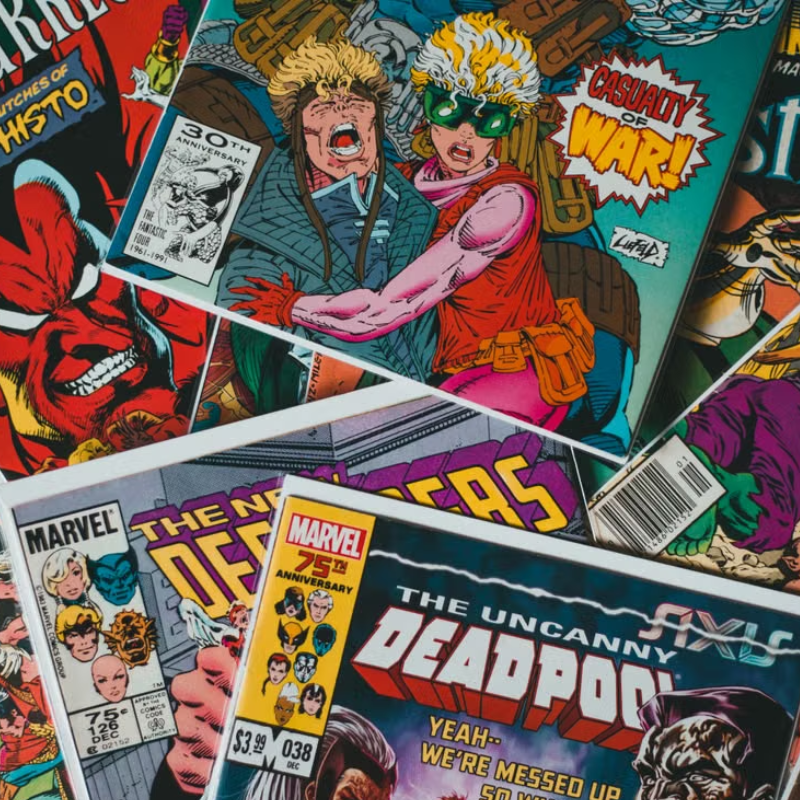

Public speaking often involves explaining concepts that are invisible:
- Confidence
- Leadership
- Fear
- Failure
- Resilience
- Creativity
- Burnout
- Change
- Strategy
- Communication
These ideas can become slippery when they’re presented only through definitions.
Fortunately, pop culture gives them faces. Instead of saying:
“Effective leaders understand that different people require different communication styles.”
A speaker might say:
“Think about how Professor X leads the X-Men. He doesn’t expect every mutant to operate the same way. Wolverine isn’t Cyclops, and Cyclops isn’t Storm. Their differences are part of the team’s strength.”
Suddenly, leadership becomes easier to visualize. The audience can see the concept rather than simply hear it… and that is a HUGE advantage.
There’s one important catch, though: Familiarity is only useful when something is actually familiar.
A reference that makes one audience laugh might leave another audience staring blankly.
A room full of Gen Z professionals may instantly understand a TikTok reference that completely misses when shared with a group of senior executives.
Likewise, a reference to a 1990s sitcom might delight one audience and confuse another.
So, before using pop culture, consider:
- Who is in the room?
- What do they watch?
- What do they listen to?
- What cultural moments do they share?
- What references might feel natural rather than forced?
This doesn’t mean you should stereotype your audiences. It means you should understand their cultural context.
After all, the best reference isn’t necessarily the coolest one; it’s the one that creates the strongest connection.
One fun way to incorporate pop culture is through hypothetical scenarios.
Ask the audience to imagine something familiar in a new context, like:
“What if The Avengers had no communication strategy?”
“What if Ted Lasso ran a Fortune 500 company?”
“What if Barbie had to give a keynote presentation to 10,000 people?”
“What if the characters from Friends had to launch a startup together?”
These questions immediately create mental images. Once the audience is imagining the scenario, the speaker can use it to introduce the actual lesson.
For example:
“Imagine the Avengers trying to defeat Thanos without communicating with one another. Iron Man does his own thing. Thor disappears. Hulk refuses to cooperate. Captain America doesn’t tell anyone the plan. They wouldn’t need a supervillain. Their communication problems would destroy the team first.”
From there, the speaker can transition naturally into a discussion about communication.
See? The reference creates the hook, while the lesson delivers the value.
Another clever technique is to use a familiar reference to shift the emotional temperature of a presentation.
For example: Imagine giving a serious presentation about failure…
You could discuss failure rates, statistics, and business case studies… or you could say:
“Remember when Ross screamed, ‘We were on a break!’?”
Most likely, you’ll get the room to laugh with that. That’s when you transition:
“Obviously, a relationship argument isn’t the same as failing at work. However, Ross’ obsession with proving that he was technically right illustrates something many professionals struggle with: Sometimes, we become so focused on defending our decisions that we stop learning from them.”
Here, the humor lowers the audience’s defenses, then the deeper lesson lands. That contrast can make serious messages feel more approachable.
Perhaps the most important rule is this: Don’t force it.
If you’re not a Marvel fan, don’t suddenly become one because you think superheroes make good presentation material.
If you don’t know TikTok culture, don’t pepper your keynote with TikTok references.
Besides, audiences can smell forced enthusiasm. The strongest references come naturally from the speaker’s own cultural vocabulary.
If you’re genuinely obsessed with “The Lord of the Rings,” use it.
If you’re a “Friends” superfan, lean into it.
If your favorite analogy comes from basketball, use basketball.
Always remember that authenticity makes the reference feel conversational rather than calculated.
Audiences generally respond better to a speaker who sounds like a human being than one who sounds like a presentation-generating machine.
Build a “Pop Culture Toolbox”
You can even keep a running list of references you might use someday!
Whenever a movie, show, song, meme, advertisement, or cultural moment reminds you of a professional concept, write it down.
Create categories such as:
- Leadership – “Ted Lasso,” “The Avengers,” “The Lord of the Rings”
- Teamwork – “Inside Out,” “Toy Story,” “The Avengers”
- Creativity – “Barbie,” “Everything Everywhere All at Once,” “Spider-Man: Into the Spider-Verse”
- Failure – “Rocky,” “The Pursuit of Happyness,” “Ted Lasso”
- Communication – “The Office,” “Friends,” “Modern Family”
- Change – “The Matrix,” “The Lion King,” “Harry Potter”
Over time, you’ll build your own library of analogies. Then, when you’re preparing a presentation, you don’t have to invent an analogy from scratch.
You simply ask:
“What does this remind me of?”
That question can unlock surprisingly powerful ideas.
So, the next time you’re preparing a speech, don’t immediately ask:
“What else should I tell them?”
Ask:
“What do they already know that could help them understand this?”
Maybe your lesson about teamwork suddenly looks like “The Avengers.”
Maybe your discussion about workplace culture starts to resemble “The Office.”
Maybe your explanation of resilience reminds everyone of “Rocky.”
Maybe your leadership lesson makes more sense through “Ted Lasso.”
Maybe your point about identity becomes clearer through “Barbie.”
Your reference doesn’t need to steal the show; it simply needs to open the door.
… because when an audience recognizes something they already love, something interesting happens: The distance between speaker and listener gets a little smaller.
… and when that distance disappears, even the most complicated idea can suddenly feel like something worth listening to.
Keep these tips in mind for your next public speaking engagement!
About The Dynamic Marketing Communiqué’s
“Thursdays: Speak on the Shoulders of Giants”
In a meeting with one person…
… a boardroom with five people…
… or a huge venue with hundreds of people…
—whatever the situation or setting, it’s very important to learn and eventually master the art of public speaking.
No matter what, you always need to effectively get your message across.
What good is a presentation with awesome content if you don’t deliver it properly?
Every Thursday, we publish different tips, insights, and secrets on how you can improve your presentation skills to captivate your audience and lead interesting discussions.
The need for great presentation skills applies EVERYWHERE.
(Small meetings with your team, big meetings with your boss, an important marketing pitch, speaking engagements for events with a big audience, etc.)
Learning these skills is not just for the corporate world. Being in other industries such as the Arts, Information Technology, Medicine, and Education while knowing how to communicate and present well will definitely give you an edge.
Have that advantage.
Hope you find this week’s public speaking tip interesting and helpful.
Stay tuned for next Thursday’s “Speak on the Shoulders of Giants!”
Cheers,
Henry Desai
Managing Director
Valens Dynamic Marketing Capabilities
Powered by VX Dynamic
www.vxdynamic.com
