
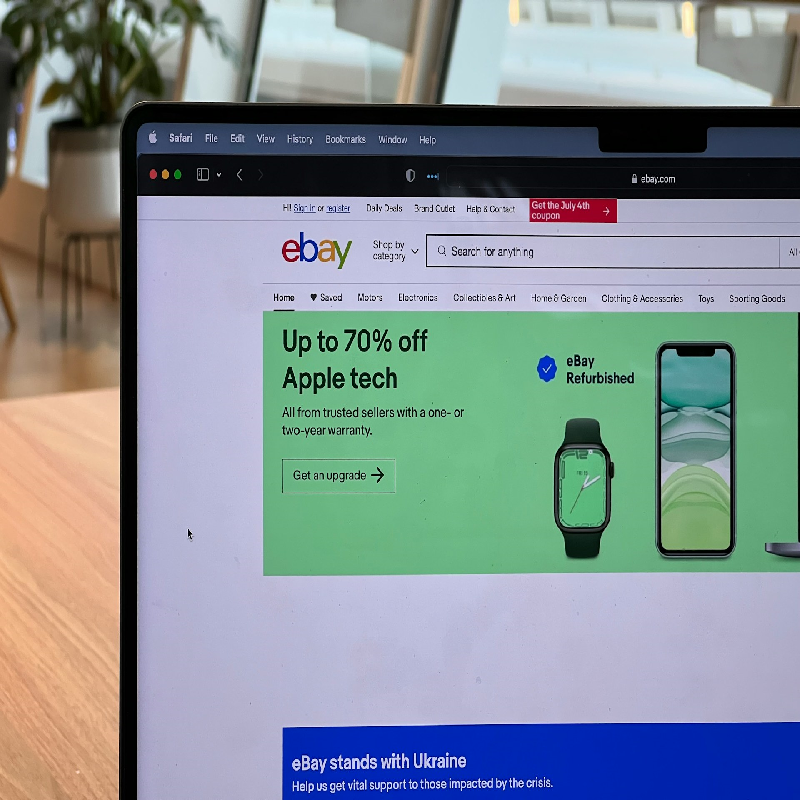

Tech juggernauts like Amazon and Microsoft have captured the market’s attention as they’ve brought in billions of dollars in revenue, thanks to their artificial intelligence (AI) and cloud computing offerings.
While these industry giants are busy grabbing headlines, a 30-year-old e-commerce firm has quietly outperformed both… and the most surprising thing about this?
This company has done that through its clever integration of AI into its operations!
That’s why today, we’re going to talk about this e-commerce giant and reveal how its innovative approach to AI has made it an overlooked yet successful story!

Photo from Unsplash
Using AI to Turbocharge Operations
eBay is one of e-commerce’s big players, yet when people encounter the name, they’d rarely associate it with AI. However, it’s precisely the latter that’s enabled it to outperform both Microsoft and Amazon.
Microsoft’s stock is up 16% year to date while Amazon is only up 4%.
eBay’s stock, on the other hand, is up a whopping 32% year to date… and instead of this surge being fueled by expanded operations or flashy deals, it’s primarily due to CEO Jamie Iannone’s decision to pair decades of proprietary data with cutting-edge AI tools.
Before Iannone took over as CEO in 2020, eBay lagged behind Amazon.
In the year prior, eBay’s revenue hovered around USD 7 billion, paling in comparison to Amazon’s USD 280 billion.
Iannone worked at eBay from 2001 to 2009. Then, he went on to run Barnes & Noble’s e-book business and later on, ran Walmart’s e-commerce unit. Simply said, he was no stranger to the world of e-commerce.
Once he was appointed CEO, he focused eBay’s attention back to some of its original strengths.
For example, instead of trying to outgrow its competitors, eBay focused on used and refurbished items—a great market to be in especially when money is tight for consumers.
By 2021, revenue had improved to around USD 10 billion.
However, the real game-changer happened last year… when eBay made a big bet on AI.
The company designed and deployed proprietary large language models (LLMs) that work well in tasks such as creating item descriptions and predicting prices.
Similar tools were then given to sellers, helping them write product descriptions, set prices, automate replies to customer queries, and even create product listing images by making a few prompts. These additions made it easier to sell items.
At present, all these tools have helped around 10 million sellers post over 200 million item listings.
That’s not all. AI is also being used to identify product trends on social media—from vintage Oasis merchandise to clothing similar to Taylor Swift’s engagement dress.
These tools have even been used to improve email campaigns, leading to 40% more engagement from customers.
An Overlooked Success Story Seen Through the Lens of RDS
As mentioned above, eBay’s clever utilization of AI has given it a significant boost, making it a case study on what real AI monetization could look like.
However, beyond that, it tells something about high-performing companies… and it’s best explained through RDS’ fifth tenet: Innovate Offerings.
In the book, “Driven,” Professor Joel Litman and Dr. Mark L. Frigo emphasized the importance of innovation.
According to them, customer needs change over time and so do the methods needed to fulfill them adequately. That’s why rapid innovation is crucial, because offerings can quickly become obsolete.
With AI rapidly reshaping how industries work, innovation activities can make or break a company.
In eBay’s case, its shrewd use of AI has allowed it to boost its prospects significantly, even allowing it to outperform Big Tech giants.
So, if you want an example on what AI monetization and innovation looks like, look no further than eBay!
Its success story is a case study in how businesses can thrive in today’s AI-dominated landscape.
—
If you’re looking to gain a better understanding of Return Driven Strategy and Career Driven Strategy, we highly recommend checking out “Driven” by Professor Litman and Dr. Frigo.
Click here to get your copy and learn how this framework can help you in your business strategies and ultimately, in ethically maximizing wealth for your firm.
About The Dynamic Marketing Communiqué’s
“Tuesdays: Return Driven Strategy”
In the book, “Driven,” authors Professor Joel Litman and Dr. Mark L. Frigo said that the goal of every long-term successful business strategy should incorporate the combined necessity of “making the world a better place” and “getting wealthy.”
That is why they created Return Driven Strategy and Career Driven Strategy—frameworks that were built to help leaders and professionals plan and evaluate businesses so they can also help others achieve their organizational goals and career goals.
The frameworks describe the plans and actions that drive returns for anyone in an organization such as independent contractors, marketers, brand managers, communicators, and other people in any field. These actions lead to the creation of wealth and value for customers, employees, shareholders, and the society.
Every Tuesday, we’ll highlight case studies, business strategies, tips, and insights related to Return Driven Strategy and Career Driven Strategy.
In planning, building, or managing brands and businesses, these strategies, case studies, and guidelines will help you choose what specific actions to take and when to take them.
Hope you find this week’s topic interesting and helpful.
Stay tuned for next Tuesday’s “Return Driven Strategy!”
Cheers,
Adrian Kyle Vergara
Content Writer
Valens Dynamic Marketing Capabilities
Powered by VX Dynamic
www.vxdynamic.com
