


The 2025 Nobel Prize in Economics wasn’t simply a nod to academia like many others before—it was a mirror to the market.
Joel Mokyr, Philippe Aghion, and Peter Howitt were recognized for their work on “creative destruction,” a concept that explains how growth depends on dismantling the old to make room for the new.
Photo from Unsplash
The concept is a reminder that innovation is rarely ever incremental. Instead, it’s a cycle of disruption and rebirth.
Now, we have artificial intelligence (“AI”) to thank for accelerating this cycle further… and it’s influencing corporate America heavily.
Creative Destruction is Reshaping Corporate America
Big firms are gutting their legacy operations to fund the future, even when those old cash cows are still generating money.
They know the payoff will come from the next big innovation. Right now, it’s playing out in the ranks of the world’s most valuable firms.
That’s why OpenAI, Nvidia, Microsoft, and Meta are pouring billions of dollars in AI-related ventures because thus far, AI-focused giants like them are pulling ahead fast, and they want to keep it that way.
Aghion and Mokyr helped formalize a powerful concept.
It’s simply that economic growth stems from innovation cycles, each one wiping out the last. In their model, new technologies don’t add to existing systems—they replace them.
To sum up, their theory, once academic, is now crucial. Firms that want to survive and thrive in the future need to adopt creative destruction as a survival instinct.
Nowadays, AI is speeding up that replacement cycle dramatically.
Large language models and machine learning tools are collapsing timelines, removing bottlenecks, and rendering entire categories of human labor obsolete.
Companies that recognize this and act on it are being rewarded.
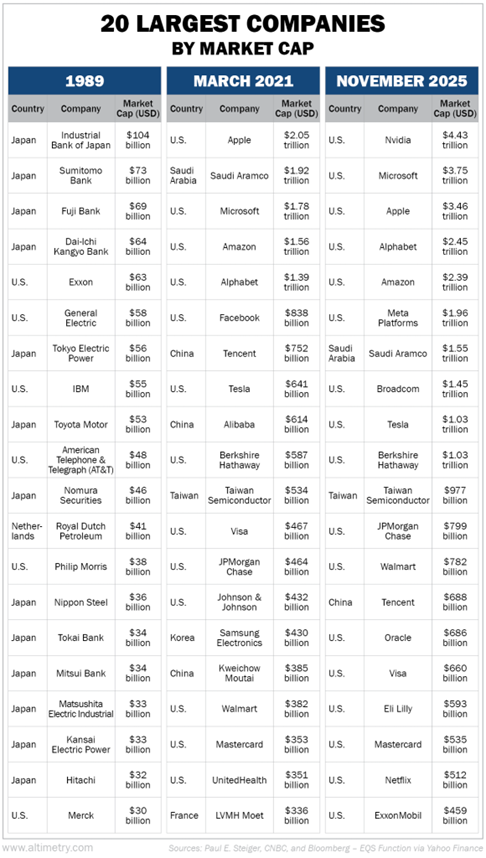
Professor Joel Litman, Chairman and CEO of Valens Research and Chief Investment Officer of Altimetry Financial Research, and his team have observed this in their research of the top 20 companies by market capitalization from 1989 to today.
Take a look:
Data chart from Altimetry
Nvidia has jumped several spots, fueled by its leadership in graphics processing units (GPUs) that power AI infrastructure.
Microsoft is embedding AI into everything, from Office to Azure. Alphabet has ramped up AI integration across its search, cloud, and ad products.
Even Amazon, long seen as an e-commerce play, is now positioning itself as a backbone for AI development through AWS.
Tech was already dominant back in 2021. Now, AI-forward tech is beating out everything else.
What we’re witnessing in the stock market today is creative destruction. The companies that we’ve seen rise to the top are the ones making all the big moves.
… but beyond all of this, what else does this concept tell you about high-performing businesses?
Well, that answer is best understood through RDS’ second foundation: Vigilance to forces of change.
Professor Litman and Dr. Mark L. Frigo in the book, “Driven,” emphasized the importance of being vigilant to forces of change such as technological innovations.
According to them, forces of change such as that can “rock the business from all directions,” driving risks and opportunities. Whether a business fails or succeeds will depend on how well management understands and prepares for these factors.
This is why today’s tech giants that are going all in on AI and shedding parts of their businesses are still raking in money. They’re embracing the future and avoiding complacency entirely.
Simply said, the businesses of today are destroying what worked yesterday to build what will enable them to win tomorrow.
—
If you’re looking to gain a better understanding of Return Driven Strategy and Career Driven Strategy, we highly recommend checking out “Driven” by Professor Litman and Dr. Frigo.
Click here to get your copy and learn how this framework can help you in your business strategies and ultimately, in ethically maximizing wealth for your firm.
About The Dynamic Marketing Communiqué’s
“Tuesdays: Return Driven Strategy”
In the book, “Driven,” authors Professor Joel Litman and Dr. Mark L. Frigo said that the goal of every long-term successful business strategy should incorporate the combined necessity of “making the world a better place” and “getting wealthy.”
That is why they created Return Driven Strategy and Career Driven Strategy―frameworks that were built to help leaders and professionals plan and evaluate businesses so they can also help others achieve their organizational goals and career goals.
The frameworks describe the plans and actions that drive returns for anyone in an organization such as independent contractors, marketers, brand managers, communicators, and other people in any field. These actions lead to the creation of wealth and value for customers, employees, shareholders, and the society.
Every Tuesday, we’ll highlight case studies, business strategies, tips, and insights related to Return Driven Strategy and Career Driven Strategy.
In planning, building, or managing brands and businesses, these strategies, case studies, and guidelines will help you choose what specific actions to take and when to take them.
Hope you find this week’s topic interesting and helpful.
Stay tuned for next Tuesday’s “Return Driven Strategy!”
Cheers,
Adrian Kyle Vergara
Content Writer
Valens Dynamic Marketing Capabilities
Powered by VX Dynamic
www.vxdynamic.com
