


There’s an unwritten rule in the business world: Only those who anticipate challenges, seize opportunities, and execute with precision rise to the top.
Yet, many organizations, regardless of their size or industry, often find themselves stuck in a cycle of incremental gains or, worse, stagnation.
What actually separates thriving enterprises from those that are merely surviving?
You see, it’s not just about innovation or having deep pockets; it’s also about having a framework that brings every decision and action into alignment with long-term value creation.
This is where a game-changing approach comes into play, helping organizations not only aim for success but also sustain it.
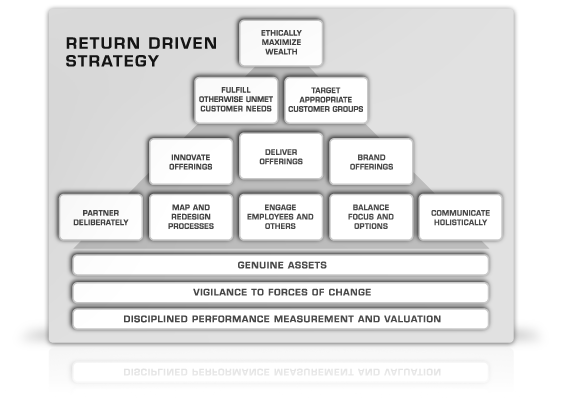
Photo from Return Driven Strategy
The Framework that Transforms Strategy
Return Driven Strategy (RDS) is not just a theoretical concept; it’s also a practical and proven framework that has been reshaping how businesses approach growth, risk, and value creation.
Developed by Professor Joel Litman and Dr. Mark L. Frigo, RDS provides a roadmap to achieve sustainable success by focusing on delivering superior financial returns while meeting the needs of customers and other stakeholders.
What’s more?
What makes RDS particularly powerful is its adaptability across different sectors and contexts, from corporate giants to academic institutions.
Take a look below!
-
Corporate Applications: From Billion-Dollar Giants to Family-Owned Firms
RDS has found its way into the strategic planning and consulting practices of companies with revenues ranging from a few million to billions of dollars annually.
Executives from some of the world’s largest and most successful organizations—as well as those leading companies facing significant challenges—have adopted this framework to guide their strategic decisions.
In many cases, RDS has become a cornerstone of strategic planning workshops and management seminars. Companies use the framework to align their objectives with value-driven principles, ensuring every department and team works toward shared goals.
This alignment not only boosts operational efficiency but also fosters innovation by keeping the focus on meeting customer needs in transformative ways.
-
Strategic Risk Management: Mitigating Threats, Amplifying Opportunities
One of the standout features of RDS is its integration with enterprise risk management (ERM). By aligning ERM with the RDS framework, organizations can evaluate risks not merely as threats but as opportunities for growth.
This approach shifts the focus from defensive tactics to proactive strategies that protect and create shareholder value.
For instance: Directors and executives leveraging RDS can identify key risks that might erode value and develop countermeasures to address them effectively.
By explicitly linking risk and strategy, organizations make risk management an integral part of their planning and review processes, enhancing their ability to achieve enterprise objectives while safeguarding their future.
-
Revolutionizing Business Education
The influence of RDS extends beyond boardrooms and corporate offices; it has also become a vital part of business education worldwide!
In fact, graduate-level business programs in top-tier institutions have adopted RDS to train the next generation of business leaders.
The framework is used in case studies, research projects, and executive MBA courses, enabling students to understand the practical application of strategic principles.
For example: At DePaul University’s Kellstadt Graduate School of Business, RDS serves as the centerpiece of an MBA concentration called “SEV”—Strategy, Execution, and Valuation.
Students in this program explore how to align strategy with value creation, graduating with a deep understanding of how to apply these concepts in real-world scenarios.
The framework’s emphasis on linking strategy with execution and valuation equips them with a holistic perspective, making them valuable assets to their organizations.
Why RDS Matters
Overall, RDS’s adaptability and focus on long-term value creation make it a powerful tool for organizations across industries.
Whether it’s used to steer strategic planning, align risk management with business goals, or educate future leaders, the framework provides a clear path to success.
Aside from that?
By concentrating on fulfilling customer needs, innovating continuously, and maintaining operational excellence, RDS helps companies navigate the complexities of modern markets with confidence.
—
In a world where change is constant and competition fierce, having a framework like RDS can mean the difference between fleeting success and enduring impact.
By focusing on what truly matters—creating value for all stakeholders—businesses can achieve not just profitability but also purpose-driven growth.
Ready to explore how RDS can transform your organization or career?
This proven framework offers insights and strategies that can help you take your game to the next level!
… and if you’re looking to gain a better understanding of Return Driven Strategy and Career Driven Strategy, we highly recommend checking out “Driven” by Professor Litman and Dr. Frigo.
Click here to get your copy and learn how this framework can help you in your business strategies and ultimately, in ethically maximizing wealth for your firm.
About The Dynamic Marketing Communiqué’s
“Tuesdays: Return Driven Strategy”
In the book, “Driven,” authors Professor Joel Litman and Dr. Mark L. Frigo said that the goal of every long-term successful business strategy should incorporate the combined necessity of “making the world a better place” and “getting wealthy.”
That is why they created Return Driven Strategy and Career Driven Strategy―frameworks that were built to help leaders and professionals plan and evaluate businesses so they can also help others achieve their organizational goals and career goals.
The frameworks describe the plans and actions that drive returns for anyone in an organization such as independent contractors, marketers, brand managers, communicators, and other people in any field. These actions lead to the creation of wealth and value for customers, employees, shareholders, and the society.
Every Tuesday, we’ll highlight case studies, business strategies, tips, and insights related to Return Driven Strategy and Career Driven Strategy.
In planning, building, or managing brands and businesses, these strategies, case studies, and guidelines will help you choose what specific actions to take and when to take them.
Hope you find this week’s topic interesting and helpful.
Stay tuned for next Tuesday’s “Return Driven Strategy!”
Cheers,
Adrian Kyle Vergara
Content Writer
Valens Dynamic Marketing Capabilities
Powered by VX Dynamic
www.vxdynamic.com
