


Adobe has continued to dominate the world of creative software for decades.
With products like Photoshop, Illustrator, and Premiere Pro, the company established itself as the software company of choice for creative industry professionals.
In 2013, the company pivoted its business model and was met with skepticism from both Wall Street and customers.
After more than a decade, Adobe stands tall in its industry, proving that its direction to pivot was correct.
So, what exactly happened?

Photo from Unsplash
Back in the 2000s, customers from the design industry paid upwards of USD 2000 in lifetime licenses to maintain access to Adobe’s software offerings.
Intervals for software upgrades to the programs would come in cycles of a year or two.
Each time a new interaction of Adobe’s creative offerings were released, users were given the option to upgrade or keep the existing version of the software solution they already bought.
By 2013, Adobe pivoted and announced that it was abandoning its perpetual license business model in favor of a “Creative Cloud” users paid for on a monthly or yearly basis to maintain access.
In other words, the company pivoted to a Software as a Service (SaaS) company—a move that didn’t sit well with both consumers and Wall Street.
From a customer perspective, the shift saddled them with monthly or annual fees instead of a one-time, upfront payment.
Meanwhile, in the eyes of analysts, a shift of this kind meant a decline in net income in the short term due to a change in pricing and lower customer retention rates.
In fact, this actually happened, as a year after the shift, Adobe’s income fell 35% because the cost for its software solutions fell… but as history has shown, this was a temporary bump.
Despite the pivot, there simply wasn’t a better alternative to the software giant’s offerings, which meant consumers would continue using those products in spite of the cost.
Adobe’s stock had nearly tripled by the end of 2016 and since its shift to SaaS, the software company’s annual revenue stood at over USD 21 billion as of 2024.
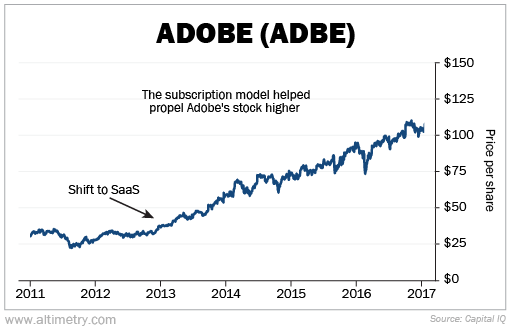
Data from Altimetry
Based on the chart above, the company is a prime example of how powerful a pivot can be, especially when it unlocks higher levels of performance.
Adobe’s Pivot Seen Through RDS’ Lens
Map and redesign processes—RDS’ eighth tenet explains Adobe’s pivot.
According to Professor Joel Litman and Dr. Mark L. Frigo in the book, “Driven”:
“Just because an activity has been done a certain way for decades does not mean that it needs to continue to be done that same way in the future.”
By shifting to SaaS, Adobe positioned itself to generate higher returns and deliver better shareholder value.
While the company faced short-term costs for its transformation, the success it enjoys today shows that the momentary setback it experienced was worth it.
The bottom line?
A change in how a company does its business can unlock higher levels of financial performance and shareholder value.
If Adobe’s story teaches anything, it’s that when done right, pivots can lead to long-term dominance, even if it brings about short-term struggles.
—
If you’re looking to gain a better understanding of Return Driven Strategy and Career Driven Strategy, we highly recommend checking out “Driven” by Professor Litman and Dr. Frigo.
Click here to get your copy and learn how this framework can help you in your business strategies and ultimately, in ethically maximizing wealth for your firm.
About The Dynamic Marketing Communiqué’s
“Tuesdays: Return Driven Strategy”
In the book, “Driven,” authors Professor Joel Litman and Dr. Mark L. Frigo said that the goal of every long-term successful business strategy should incorporate the combined necessity of “making the world a better place” and “getting wealthy.”
That is why they created Return Driven Strategy and Career Driven Strategy—frameworks that were built to help leaders and professionals plan and evaluate businesses so they can also help others achieve their organizational goals and career goals.
The frameworks describe the plans and actions that drive returns for anyone in an organization such as independent contractors, marketers, brand managers, communicators, and other people in any field. These actions lead to the creation of wealth and value for customers, employees, shareholders, and the society.
Every Tuesday, we’ll highlight case studies, business strategies, tips, and insights related to Return Driven Strategy and Career Driven Strategy.
In planning, building, or managing brands and businesses, these strategies, case studies, and guidelines will help you choose what specific actions to take and when to take them.
Hope you find this week’s topic interesting and helpful.
Stay tuned for next Tuesday’s “Return Driven Strategy!”
Cheers,
Adrian Kyle Vergara
Content Writer
Valens Dynamic Marketing Capabilities
Powered by VX Dynamic
www.vxdynamic.com
