
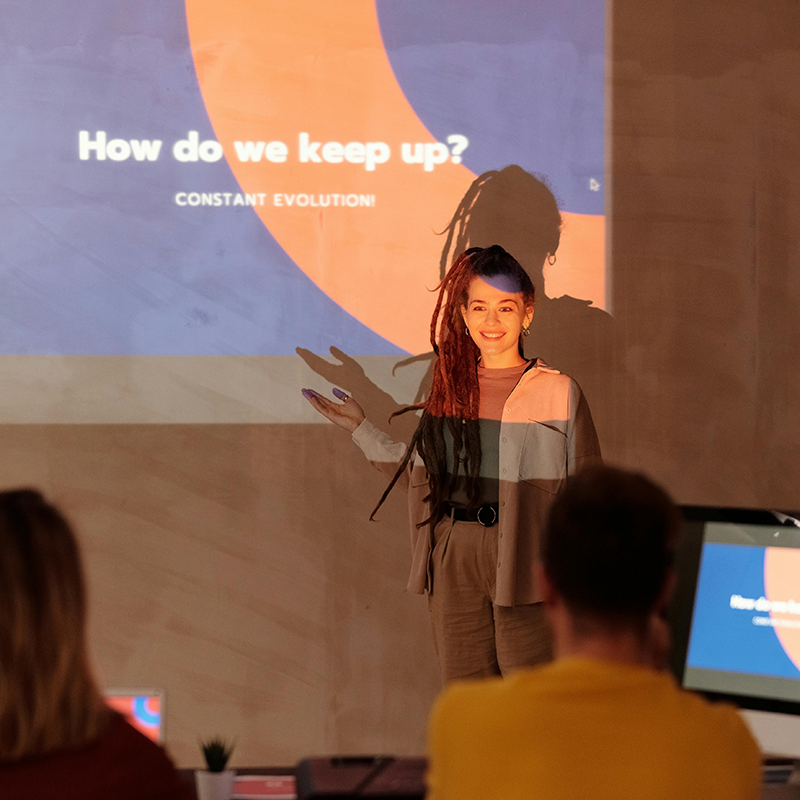

When you do anything difficult for a living, little things always make a BIG difference.
… and one of those difficult things is public speaking.
You see, Scott Berkun, the author of the book, “Confessions of a Public Speaker,” says over the years in his public speaking career, he’s come across some reliable advantages that help him and anyone, regardless of how often they speak.
So today, we’ll talk about the not-so-little “little” things that pros do in a public speaking engagement.
-
The Confidence Monitor
-
The Countdown Timer
-
The Remote Control
-
The Giveaway Stuff
-
The Wireless Microphone
-
The Badges or Name Tags
If you are on stage, you can assume you don’t need a name tag. People know who you are. You’re the one with the microphone.
A badge is only distracting and can even get caught in your hands. Good hosts catch this before speakers go on and remind them to take off the name tag.
-
The Camera
These days, many presentations are videotaped, which means it’s possible your real audience is not the crowd in front of you but the people who will watch online in the months and years that follow.
In fact, many more people watch TED talks over the Internet than attend the conference in California!
… and if you’re smart, you will treat your cameramen well. After all, they can do all kinds of things to make you look or sound stupid, so make sure to get on their good side.
Ask their names, ask their advice, and treat them like people equal to you, not servants.
Also, when you’re preparing for your speech or presentation, craft your material and slides with the online audience in mind.
Keep in mind that you’re projecting not just to the back row in the room, but also to the people who will watch on a tiny window on a computer monitor.
Eye contact is necessary to connect with an audience.
However, according to Berkun, this could be a challenge when your slides are projected behind you on a screen. To make sure the audience sees what you think they’re seeing, you’ll be tempted to turn and look at the screen or stay behind the lectern.
The solution for that?
A confidence monitor!
It’s usually placed at the front of the stage to show speakers exactly what’s on the screen.
To utilize this tool in public speaking, Berkun recommends preparing your slides via PowerPoint or Keynote, as these have presenter modes that let the confidence monitor show you not only the current slide but also a small version of the next, or even the notes you’ve prepared.
It’s very hard to track the time while speaking. For this reason, big events often place a countdown timer next to the confidence monitor.
Some of these clocks have three lights—red, yellow, and green—to indicate how much time is left. Green is how you start, yellow means one or five minutes remain, and red means you’re done.
In some instances, good hosts hold up paper signs that read, “10 minutes,” “5 minutes,” and “Wrap it up,” as appropriate. Some speakers can take care of this themselves if they have the right remote control.
Berkun states occasionally, you’ll see a speaker so unaware of the value of a remote that he or she runs back and forth from center stage to the lectern, only for the sake of advancing slides.
This is called the “circle of slide death,” the circle being made by the speaker on every round trip.
That’s why for him, having a remote control in your hand gives you complete freedom! You can do whatever you want at any time—roam the stage, go into the crowd, stand behind the lectern, or make a few points from the last row (but always check with the tech crew, as wireless microphones can create feedback if you leave the stage).
In some events, a remote control is provided by the organizers… but just to be sure, make this part of your to-bring list every time you have a public speaking engagement. Invest in a good remote control.
Berkun says the front row at lectures is like the Bermuda Triangle; no one wants to sit there for fear of being embarrassingly bored or not being able to escape.
In Berkun’s case, he often brings books to give away during Q&A, but if the front row is empty, he usually offers a free book to anyone who is willing to move to the front.
It always works to his advantage, entertains those who are too lazy to move, and makes the audience seem much less threatening to him.
So, like Berkun, what are things that you can give away to your audience to make them interested in what you have to say?
Books?
Notebooks?
Pens?
Whatever that is, always prepare a few of these things and you’ll eventually see your front row being filled up with people who are interested to listen to you.
Most events use wireless microphones, which require clipping a lapel mic to your shirt. Dress shirts are the best for this, as they provide the most reliable way to clip on such a microphone.
This doesn’t mean you can no longer wear a sweater or T-shirt when you’re delivering a speech or presentation, but you have to consider the implications.
On these types of clothing, the lapel mic will pinch the fabric, which is easy to notice. This is an antithesis to the goal of the wireless mic, which is to be as inconspicuous as possible.
Take note of these tips for your future public speaking engagements!
Always remember: In BIG events where you’ll be speaking, it’s these little things that matter and make a BIG difference.
About The Dynamic Marketing Communiqué’s
“Thursdays: Speak on the Shoulders of Giants”
In a meeting with one person…
… a boardroom with five people…
… or a huge venue with hundreds of people…
—whatever the situation or setting, it’s very important to learn and eventually master the art of public speaking.
No matter what, you always need to effectively get your message across.
What good is a presentation with awesome content if you don’t deliver it properly?
Every Thursday, we publish different tips, insights, and secrets on how you can improve your presentation skills to captivate your audience and lead interesting discussions.
The need for great presentation skills applies EVERYWHERE.
(Small meetings with your team, big meetings with your boss, an important marketing pitch, speaking engagements for events with a big audience, etc.)
Learning these skills is not just for the corporate world. Being in other industries such as the Arts, Information Technology, Medicine, and Education while knowing how to communicate and present well will definitely give you an edge.
Have that advantage.
Hope you find this week’s public speaking tip interesting and helpful.
Stay tuned for next Thursday’s “Speak on the Shoulders of Giants!”
Cheers,
Henry Desai
Managing Director
Valens Dynamic Marketing Capabilities
Powered by VX Dynamic
www.vxdynamic.com
